
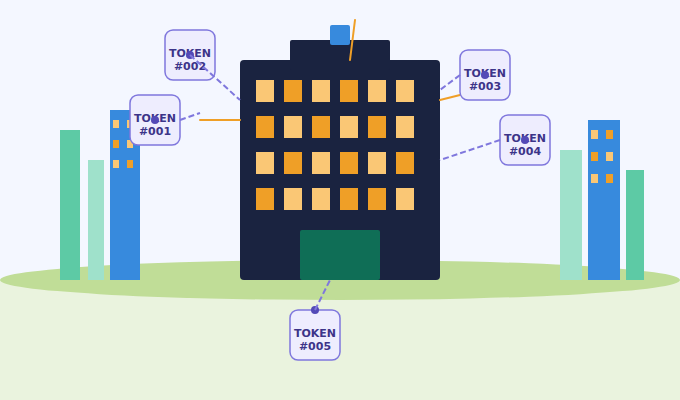
Commercial real estate has long been considered one of the most attractive asset classes for institutional and high-net-worth investors. Office towers, multifamily developments, industrial facilities, retail centers, and hospitality assets have historically generated stable cash flow, tax advantages, and long-term appreciation. Yet despite these benefits, commercial real estate has remained relatively illiquid, capital-intensive, and difficult for many investors to access.
The emergence of blockchain technology and digital securities is changing that dynamic through the tokenization of commercial real estate assets.
Tokenization represents one of the most significant structural innovations in real estate finance in decades. By converting ownership interests in real estate into digital tokens recorded on a blockchain, sponsors and investors can potentially unlock new sources of capital, improve liquidity, enhance transparency, and broaden investor participation.
What Is Real Estate Tokenization?
At its core, tokenization is the process of representing ownership rights in a real-world asset as digital tokens on a blockchain network.
In commercial real estate, these tokens typically represent:
- Equity ownership in a property or portfolio
- Membership interests in an LLC
- Shares in a real estate fund
- Participation in debt instruments such as first-position loans or mezzanine financing
- Revenue-sharing rights tied to cash flow distributions
Each token functions similarly to a traditional security, but with ownership and transaction records maintained digitally on a decentralized ledger.
For example, a $50 million multifamily asset could be divided into 500,000 digital tokens valued at $100 each. Investors could then purchase fractional ownership interests in the property, receiving proportional distributions from rental income and appreciation.
Why Tokenization Matters
Traditional commercial real estate investing has several inherent limitations:
- High minimum investment thresholds
- Limited liquidity
- Lengthy transaction processes
- Significant legal and administrative overhead
- Restricted access to institutional-quality deals
Tokenization seeks to address these inefficiencies.
Fractional Ownership
Historically, direct ownership in commercial real estate required substantial capital commitments. Tokenization enables fractional ownership, allowing investors to participate with significantly smaller investment amounts.
This democratization of access opens institutional-quality assets to a broader investor base while allowing sponsors to raise capital more efficiently.
Enhanced Liquidity
Commercial real estate is traditionally illiquid. Investors often remain locked into investments for five to ten years or longer until refinancing or disposition occurs.
Tokenized assets introduce the possibility of secondary market trading, where investors may buy and sell ownership interests more efficiently through regulated digital marketplaces. While liquidity remains dependent on market participation and regulatory compliance, tokenization has the potential to narrow the gap between private real estate and publicly traded securities.
Operational Efficiency
Blockchain technology can streamline several administrative functions:
- Investor onboarding
- Cap table management
- Distribution processing
- Compliance reporting
- Transfer restrictions
- Recordkeeping
Smart contracts can automate many of these functions, reducing administrative costs and minimizing manual errors.
Transparency and Security
Blockchain ledgers provide immutable transaction records, increasing transparency for sponsors, investors, auditors, and regulators. Ownership history, transfers, and distributions can be tracked in real time with greater accuracy than many legacy systems.
The Structure Behind Tokenized Real Estate
While the concept may appear highly technical, most tokenized real estate transactions follow a familiar legal framework.
Typically:
- A sponsor acquires or controls a property.
- The property is held within a legal entity such as an LLC.
- Digital tokens represent ownership interests in that entity.
- Investors purchase tokens through a compliant securities offering.
- Distributions are paid based on ownership percentages.
Importantly, tokenized real estate remains subject to existing securities laws. In the United States, most token offerings are structured under exemptions such as Regulation D, Regulation A+, or Regulation CF.
As a result, tokenization is not a regulatory workaround — it is simply a more efficient method of issuing and managing securities.
Asset Classes Best Suited for Tokenization
While nearly any commercial real estate asset can theoretically be tokenized, certain sectors are particularly well-positioned.
Multifamily Housing
Stable cash flow, institutional demand, and broad investor familiarity make multifamily properties ideal candidates.
Industrial and Logistics
The continued growth of e-commerce and supply chain infrastructure has driven investor appetite for industrial assets, making them attractive for fractional investment structures.
Hospitality
Hotels and resort assets often benefit from broader investor participation due to strong consumer recognition and branding opportunities.
Trophy Assets
Iconic office buildings or mixed-use developments can use tokenization to expand investor access while maintaining centralized asset management.
Private Credit and Real Estate Debt
Tokenization is increasingly being explored for commercial real estate loans, bridge lending, and private credit strategies. Digital debt instruments may improve efficiency in syndication and secondary trading.
The Role of Smart Contracts
One of the most transformative aspects of tokenization is the use of smart contracts.
Smart contracts are self-executing digital agreements programmed to automate specific actions once predetermined conditions are met.
In commercial real estate, smart contracts can:
- Automatically distribute cash flow to investors
- Enforce transfer restrictions
- Verify investor accreditation
- Manage voting rights
- Execute waterfall calculations
- Maintain compliance requirements
This automation has the potential to significantly reduce administrative burdens for sponsors and fund managers.
Challenges and Risks
Despite its promise, tokenization remains an emerging sector with meaningful challenges.
Regulatory Complexity
Securities regulations vary by jurisdiction and continue to evolve. Sponsors must navigate:
- SEC compliance
- Know-your-customer (KYC) requirements
- Anti-money laundering (AML) regulations
- Transfer restrictions
- Tax considerations
Failure to properly structure offerings can create significant legal exposure.
Secondary Market Liquidity
Although tokenization promises improved liquidity, active secondary markets for tokenized real estate are still developing. Liquidity ultimately depends on investor participation, exchange infrastructure, and regulatory approvals.
Technology Adoption
Institutional adoption remains in its early stages. Many investors, lenders, and operators are still becoming familiar with blockchain infrastructure and digital wallets.
Cybersecurity and Custody
Digital asset custody introduces new operational considerations. Sponsors and investors must ensure secure storage of tokens and protection against cyber threats.
Institutional Adoption Is Accelerating
Major financial institutions, asset managers, and technology firms are increasingly exploring tokenized real-world assets.
Industry analysts believe tokenization could eventually transform trillions of dollars of traditionally illiquid assets into digitally transferable securities. Commercial real estate is widely viewed as one of the most compelling use cases because of its size, fragmentation, and operational inefficiencies.
As infrastructure improves and regulations become more clearly defined, tokenization may become a standard capital formation tool rather than a niche innovation.
The Future of Commercial Real Estate Investing
Tokenization does not replace the fundamentals of real estate investing. Asset quality, sponsorship strength, market selection, and underwriting discipline remain paramount.
What tokenization changes is the infrastructure surrounding ownership, capital formation, and investor access.
Over time, tokenization could lead to:
- Faster capital raises
- Broader investor participation
- More efficient secondary trading
- Lower administrative costs
- Increased transparency
- Global access to U.S. commercial real estate opportunities
For sponsors, tokenization offers the potential to access a wider pool of investors while modernizing operational workflows. For investors, it may provide access to institutional-quality real estate with lower minimums and greater flexibility.
While the industry is still evolving, tokenization represents a meaningful step toward the modernization of commercial real estate finance — bridging the gap between traditional real assets and the digital financial ecosystem.