
For decades, commercial real estate has been one of the most reliable ways to build long-term wealth. Office buildings, apartment communities, warehouses, retail centers, and hotels have historically generated steady cash flow while appreciating in value over time.
The problem? Access.
Traditionally, investing in commercial real estate required significant capital, insider relationships, and a willingness to lock up money for years at a time. For many investors, it simply wasn’t practical.
That’s where tokenization comes in.
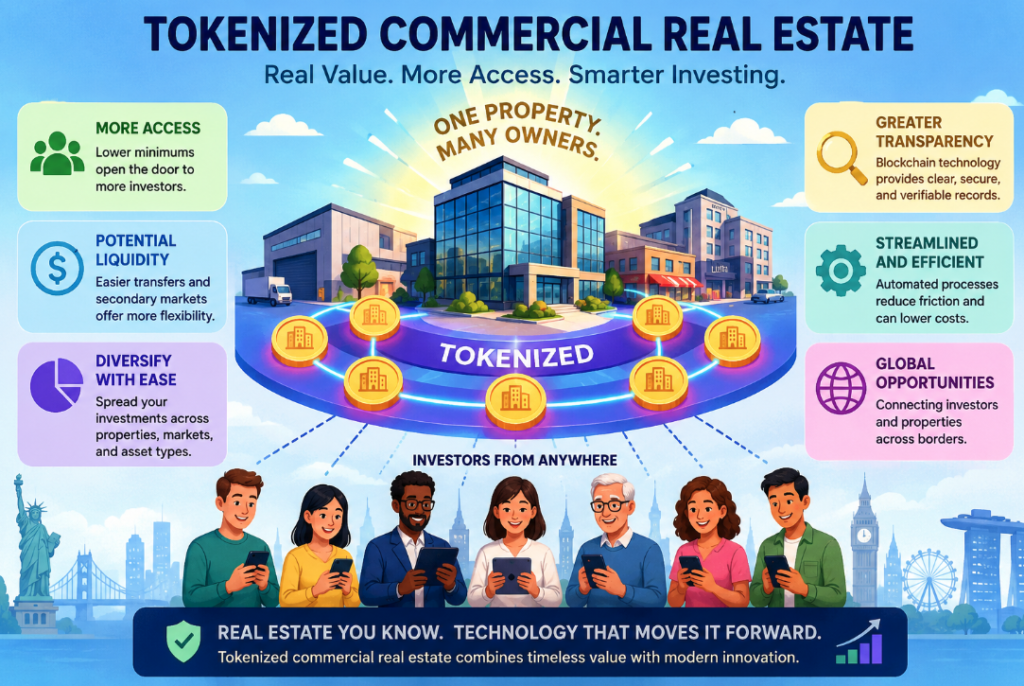
Tokenized commercial real estate is bringing a modern, technology-driven approach to property investing by combining real estate ownership with blockchain technology. In simple terms, it allows large commercial properties to be divided into smaller digital ownership shares—called tokens—that investors can buy more easily.
And that’s creating some interesting new opportunities.
So, What Exactly Is Tokenized Real Estate?
Think of tokenization like fractional ownership for commercial property.
Instead of one investor—or a small investment group—buying an entire office building, ownership can be split into thousands of digital shares. Investors can then purchase a portion of the property through a blockchain-based platform.
Each token represents an ownership interest in the underlying real estate asset.
That asset could be:
- An apartment complex
- An industrial warehouse
- A retail center
- A hotel
- A mixed-use development
- Even a portfolio of properties
The blockchain acts as a secure digital ledger that records ownership and transactions in a transparent and efficient way.
While the technology behind it can sound complicated, the concept is actually pretty straightforward: make commercial real estate investing more accessible, flexible, and efficient.
Lower Barriers to Entry
One of the biggest reasons tokenized real estate is gaining attention is because it opens the door to more investors.
Traditional commercial real estate investments often come with very high minimums. In many private deals, investors may need to contribute $50,000, $100,000, or more just to participate.
That immediately limits who can invest.
Tokenization changes the equation by allowing ownership to be divided into smaller pieces. Instead of needing a massive amount of capital, investors may be able to get exposure to commercial real estate with much smaller investments.
For many people, that’s a game changer.
It allows:
- Younger investors to enter the market earlier
- Investors to spread money across multiple properties
- More people to access institutional-quality real estate
- Smaller portfolios to participate in alternative assets
In many ways, tokenization is doing for commercial real estate what online brokerage platforms did for stock investing years ago.
Real Estate That’s Potentially More Liquid
Commercial real estate has always had one major downside: it’s not easy to sell quickly.
If you own part of a traditional real estate syndication or private fund, your money may be tied up for years. Exiting early can be difficult—or impossible.
Tokenization has the potential to improve liquidity by making ownership interests easier to transfer between investors on compliant secondary marketplaces.
Now, this doesn’t mean tokenized real estate suddenly trades like a public stock. Liquidity still depends on market demand and platform participation. But compared to traditional private real estate investing, it can offer significantly more flexibility.
For investors, that may mean:
- Easier portfolio rebalancing
- Faster transactions
- More transparent pricing
- Fewer administrative headaches
That added flexibility is a big reason the model is attracting attention.
Easier Diversification
One of the smartest things investors can do is avoid putting all their money into a single deal or market.
Tokenized real estate makes diversification easier because investors can allocate smaller amounts across multiple properties and asset types.
Instead of concentrating capital into one apartment project, an investor could spread investments across:
- Multifamily housing in Texas
- Industrial warehouses in logistics hubs
- Retail centers in growing suburban markets
- Hospitality assets in tourism-driven cities
This kind of diversification can help reduce risk while still maintaining exposure to real estate income and appreciation potential.
And because minimum investments are often lower, investors have more flexibility to build a customized portfolio.
More Transparency Through Technology
One of the interesting things about blockchain technology is that it creates a permanent and transparent record of transactions.
In traditional private real estate deals, investors sometimes have limited visibility into ownership structures, transfers, reporting, or distributions.
Blockchain-based systems can improve transparency by creating clear digital records of:
- Ownership interests
- Transactions
- Transfers
- Investor distributions
That transparency can help build confidence between sponsors and investors while reducing administrative confusion.
Streamlined Operations and Lower Friction
Traditional commercial real estate transactions can involve a surprising number of middlemen and paperwork.
There are attorneys, escrow agents, administrators, transfer agents, custodians, and compliance procedures layered into many deals.
Tokenization can simplify some of these processes through automation and smart contracts.
That may help reduce:
- Administrative costs
- Settlement times
- Paper-heavy processes
- Manual reporting requirements
For sponsors, that can create operational efficiencies. For investors, it may lead to a smoother overall experience.
Access to a Broader Investor Base
Commercial real estate has historically been a fairly localized investment business. Tokenization could make it far more global.
Because blockchain-based systems operate digitally, investors from different regions may be able to participate more easily in commercial real estate opportunities across borders—subject to applicable regulations, of course.
That broader access can potentially:
- Expand investor participation
- Increase capital availability for projects
- Improve market efficiency
- Create new opportunities for international diversification
As digital asset infrastructure continues to mature, this global accessibility could become one of the most important long-term developments in the space.
It’s Still Real Estate — And Risks Still Matter
As exciting as tokenization sounds, it’s important to remember something: the underlying investment is still commercial real estate.
That means the same risks still apply.
Properties can lose value. Tenants can leave. Markets can soften. Interest rates can impact performance.
On top of that, tokenized real estate introduces additional considerations like:
- Regulatory uncertainty
- Platform security
- Technology adoption
- Liquidity limitations
- Sponsor quality
Like any investment, due diligence matters.
Investors should understand both the real estate fundamentals and the structure of the tokenized offering before committing capital.
Where This Could Be Headed
Tokenized commercial real estate is still relatively early in its evolution, but momentum is clearly building.
As blockchain infrastructure improves and regulatory frameworks become more established, many investors believe tokenization could eventually become a standard way to buy, sell, and manage private real estate investments.
The appeal is easy to understand:
- Greater accessibility
- Improved efficiency
- Better diversification
- Potentially enhanced liquidity
- Technology-enabled ownership structures
For investors looking for modern ways to access commercial real estate, tokenization represents an intriguing shift in how the market may operate in the years ahead.
Final Thoughts
Commercial real estate has always been a powerful long-term investment class, but historically it hasn’t been particularly accessible or flexible for the average investor.
Tokenization is beginning to change that.
By combining real estate with blockchain technology, tokenized commercial real estate has the potential to make investing more approachable, efficient, and diversified while opening the market to a much broader group of participants.
The industry is still developing, and there are certainly risks to consider. But for investors interested in the intersection of real estate, technology, and alternative assets, tokenization is a space worth watching closely.